An Externally Pressurized FM200 Fire Suppression System is a clean agent gas fire extinguishing system designed for areas where water, foam, or powder may cause serious secondary damage. It uses FM200, also known as HFC-227ea, as the fire extinguishing agent and uses a separate nitrogen cylinder as the driving gas source.
This type of system is also commonly described as an External Storage FM200 Fire Suppression System, External-Pressure Fire Extinguishing System, or Externally Pressurized HFC-227ea Fire Suppression System.
Compared with a conventional stored-pressure FM200 system, the externally pressurized design stores the FM200 agent and the nitrogen driving gas separately. This structure helps improve agent conveyance performance, increase discharge stability, support longer piping distance, and provide better flexibility for large protected areas or projects where the cylinder room is far from the protected zone.
For data centers, control rooms, archive rooms, libraries, computer rooms, power distribution rooms, and other critical facilities, this system provides a professional total flooding clean agent fire protection solution.
FM200, chemically known as Heptafluoropropane or HFC-227ea, is a clean gaseous fire extinguishing agent. According to the ANWETECH user manual, FM200 suppresses fire through both physical and chemical mechanisms. It has good electrical insulation performance, high fire extinguishing efficiency, and zero ozone depletion potential.
One major advantage of FM200 is that it leaves no residue after discharge. This makes it suitable for protected areas where post-discharge cleaning is difficult or where contamination is not acceptable.
Typical protected assets include:
Data servers
Control cabinets
Electrical equipment
Critical records
Computer hardware and software
Precision instruments
Archives and documents
Cultural relics and valuable collections
Because FM200 does not leave powder, foam, or water residue, it is widely used in clean agent fire suppression systems for high-value and sensitive environments.
In a traditional stored-pressure FM200 system, the FM200 agent and nitrogen are stored together inside the same cylinder. The nitrogen pressurizes the cylinder during storage and helps discharge the agent when the system activates.
An Externally Pressurized FM200 System works differently.
In this system, the FM200 agent is stored as liquid in the agent cylinder without nitrogen pressurization. The pressure inside the FM200 agent cylinder is only the saturated vapor pressure of the agent itself. The compressed nitrogen used to drive the discharge is stored separately in a high-pressure nitrogen cylinder.
When the system activates, the high-pressure nitrogen first passes through a pressure reducing device. Then it enters the FM200 agent cylinder and pushes the liquid agent through the siphon tube, container valve, piping network, and nozzles into the protected area.
This is why the system is also called:
External Storage FM200 Fire Suppression System
External-Pressure Fire Extinguishing System
Separate Nitrogen Cylinder Fire Suppression System
Nitrogen-Driven FM200 Fire Suppression System
Separate Pressure Source Fire Suppression System
The key point is simple:
FM200 agent and nitrogen driving gas are stored in different cylinders. Nitrogen only enters the FM200 agent cylinder when the system is activated.
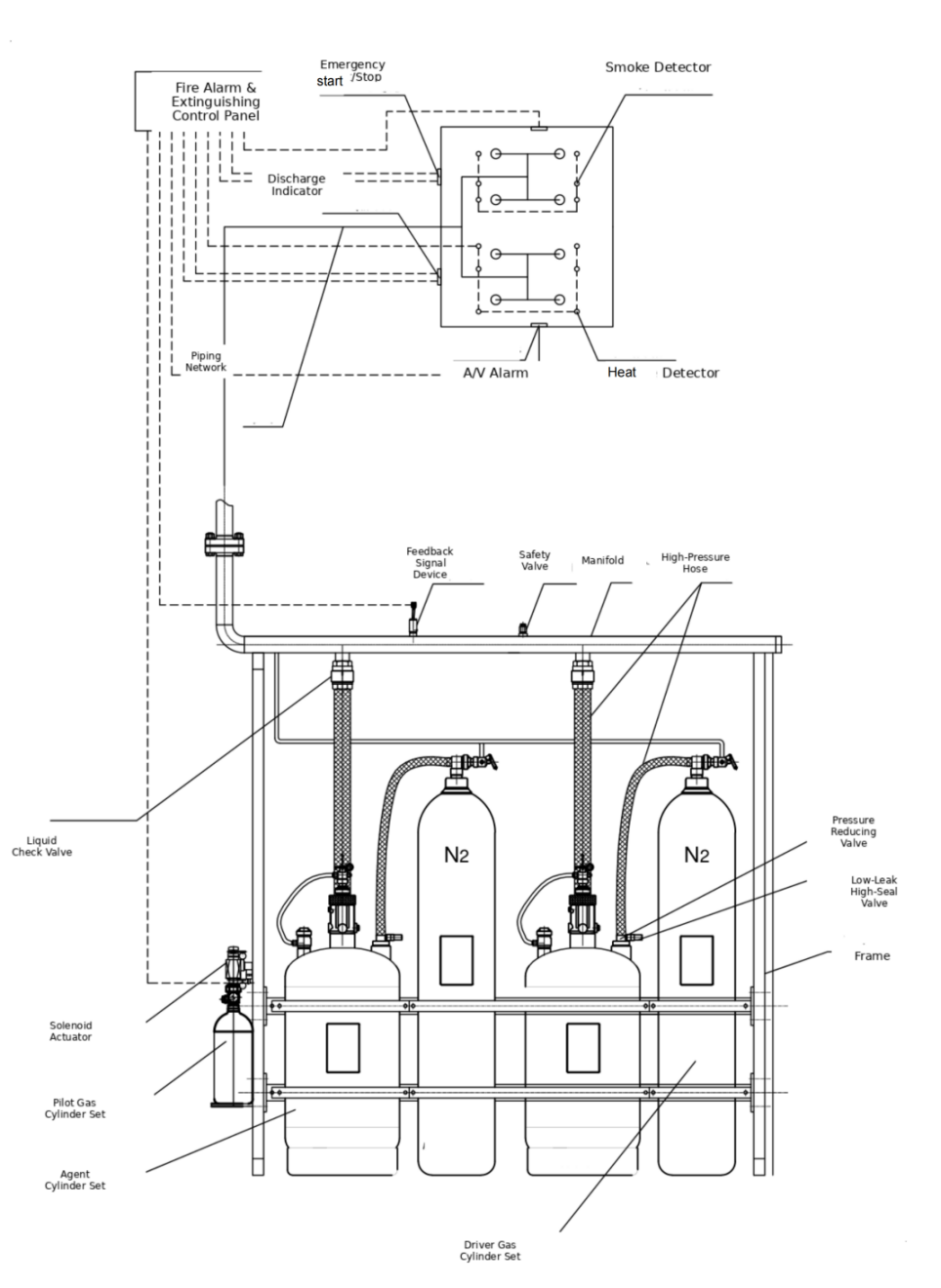
The ANWETECH externally pressurized FM200 fire suppression system includes fire detection, alarm control, distribution and release equipment, agent storage, driving gas storage, piping network, nozzles, and alarm indication devices.
The working process can be understood in several steps:
First, fire detectors installed in the protected area detect smoke, heat, or fire signals and send alarm information to the fire alarm and suppression control panel.
Second, after the system confirms the fire signal, the control panel activates audible and visual alarms. It can also send linkage signals to stop ventilation equipment, close dampers, or shut down related systems.
Third, after the preset delay time, the control panel sends a release signal to the actuation device.
Fourth, the pilot gas cylinder opens the related selector valve and driving gas cylinder valve.
Fifth, the nitrogen driving gas is released and regulated by the pressure reducing device.
Sixth, the regulated nitrogen enters the FM200 agent cylinder and pushes the FM200 agent through the piping network.
Finally, the FM200 agent is discharged through nozzles into the protected area and reaches the designed extinguishing concentration.
The system is designed for total flooding fire suppression, which means the agent fills the entire protected enclosure to suppress the fire quickly and uniformly.
The separate storage design is the most important feature of an externally pressurized FM200 system.
According to the ANWETECH manual, separating the FM200 agent and nitrogen driving gas helps solve two important technical issues.
First, during normal storage, the FM200 agent is not in contact with nitrogen. This helps avoid gas dissolution caused by nitrogen pressurization.
Second, after system activation, the agent conveyance pressure remains higher than the storage pressure. This helps prevent vapor separation and reduces the two-phase flow phenomenon during discharge.
In simple words, the agent flow becomes more stable.
The nitrogen driving gas stays behind the liquid FM200 agent and continuously pushes it forward through the piping network. Compared with a stored-pressure system, the flow is faster and more stable. This improves the agent conveyance capability of the piping network and makes the system more suitable for long-distance discharge applications.
Both systems use FM200 / HFC-227ea as the fire extinguishing agent, but their storage and discharge methods are different.
Stored-Pressure FM200 System:
FM200 and nitrogen are stored in the same cylinder.
The cylinder is pressurized during standby condition.
It is commonly used for many standard clean agent projects.
It is more suitable for normal piping distance and standard protected rooms.
The system structure is relatively simple.
Externally Pressurized FM200 System:
FM200 agent and nitrogen driving gas are stored separately.
The FM200 agent cylinder is not nitrogen-pressurized during normal standby.
Nitrogen enters the agent cylinder only during system discharge.
The system provides more stable agent flow.
It can support longer piping distance.
It is more suitable for large-volume protected areas.
It is suitable when the cylinder room is far from the protected area.
It can help improve nozzle inlet pressure and agent atomization.
It can be considered for some Halon 1301 replacement or retrofit projects.
For small and standard protected rooms, a stored-pressure FM200 system may be enough. But for large projects, long piping routes, or centralized cylinder room designs, an externally pressurized FM200 fire suppression system can provide better engineering flexibility.
One major advantage of the external storage FM200 fire suppression system is its long-distance conveyance capability. Under suitable design conditions, the maximum conveyance distance can reach up to 200 m.
This is especially useful when the cylinder room cannot be located close to the protected area.
For example:
Large data centers
Industrial control rooms
Underground equipment rooms
Large power distribution facilities
Centralized cylinder room projects
Multiple protected areas connected to one cylinder room
Because nitrogen is stored separately and enters the agent cylinder only during discharge, the system can provide more stable driving pressure.
The pressure reducing device helps regulate the nitrogen pressure before it enters the FM200 agent cylinder. This makes the agent flow more stable and reduces pressure fluctuation during discharge.
Stable discharge pressure is important for clean agent systems because it affects:
Agent flow rate
Nozzle inlet pressure
Agent atomization
Discharge uniformity
Fire extinguishing efficiency
The externally pressurized design can increase nozzle inlet pressure by adjusting the driving pressure and nitrogen configuration.
Better nozzle inlet pressure helps improve FM200 atomization. This allows the clean agent to be distributed more effectively inside the protected area.
For total flooding fire suppression, good agent distribution is very important because the entire protected space must reach the required extinguishing concentration.
In a conventional stored-pressure system, the cylinder must store both the agent and pressurized gas. In an external storage pressure FM200 system, the agent cylinder stores FM200 without nitrogen pressurization during standby.
This allows a higher filling density and better use of cylinder volume. According to the ANWETECH manual, the maximum filling density can reach up to 1249 kg/m³, helping reduce cylinder quantity and save cylinder room space.
This is valuable for projects where space is limited or where equipment room cost needs to be controlled.
Because the driving gas provides strong and stable pressure, more agent can be conveyed through the piping network. Under suitable design conditions, the piping diameter may be relatively smaller compared with some conventional arrangements.
This can help reduce piping cost and improve project flexibility.
The externally pressurized FM200 system can be suitable for retrofit projects where old Halon 1301 systems need to be upgraded to modern clean agent fire suppression systems.
In some projects, the existing cylinder room and piping network may be reused after proper engineering evaluation. This can help reduce reconstruction work and project cost.
The ANWETECH externally pressurized HFC-227ea fire suppression system is suitable for protected areas where fire must be suppressed quickly and where residue is not acceptable.
Typical applications include:
Data centers
Server rooms
Computer rooms
Control rooms
Power distribution rooms
Electrical rooms
Telecommunication rooms
Archive rooms
Libraries
Museums
Cultural relic storage rooms
Precision medical equipment rooms
Precision industrial instrument rooms
Critical record storage rooms
High-value asset rooms
Large-volume protected areas
Projects with long-distance piping
Projects where the cylinder room is far from the protected area
It is especially suitable for areas containing valuable assets, critical records, electronic equipment, and hardware or software systems.
According to the ANWETECH user manual, the FM200 fire suppression system is suitable for:
Electrical fires
Surface fires involving solid materials
Liquid fires
Gas fires where the gas supply can be shut off before discharge
However, FM200 is not suitable for every fire scenario.
It is not suitable for fires involving oxidizing chemicals, reactive metals, metal hydrides, or chemicals that can decompose by themselves, such as hydrogen peroxide or hydrazine.
This is why proper system design and fire risk evaluation are important before selecting an FM200 fire suppression system.
The ANWETECH externally pressurized FM200 system is designed as a total flooding clean agent fire suppression system.
Typical system features include:
Extinguishing agent: FM200 / HFC-227ea
Extinguishing method: Total flooding
Rated working pressure at 20°C: 4.2 MPa
Agent discharge time: ≤ 10 seconds
Agent cylinder volume: 90 L, 120 L, 150 L, 180 L
Maximum filling density: ≤ 1250 kg/m³
Driving gas: Nitrogen
Driving gas cylinder volume: 70 L
Driving gas storage pressure: 12 MPa
Pilot cylinder volume: 5 L
Pilot cylinder storage pressure: 6 MPa
Main power supply: AC 220 V, 50 Hz
Backup power supply: DC 24 V
Solenoid actuation voltage: DC 24 V
Automatic delay time: 0–30 seconds adjustable
The system supports automatic control, electrical manual control, and mechanical emergency manual control.
An externally pressurized FM200 fire suppression system is not just another clean agent system. It is designed for projects that need stronger agent conveyance capability and better engineering flexibility.
It is a better choice when:
The cylinder room is far from the protected area.
The project has long piping distance.
The protected area is large.
The system needs stable discharge pressure.
The project needs total flooding clean agent protection.
The customer wants to reduce post-discharge cleaning.
The protected area contains high-value electronic equipment or documents.
The project involves Halon 1301 replacement or system retrofit.
For engineering contractors, system integrators, and project owners, the external storage FM200 fire suppression system provides a practical solution for complex clean agent fire protection projects.

